
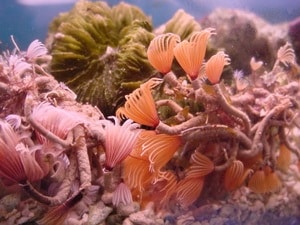
Cluster Duster Worms A colony of filter feeding worms similar to but smaller than feather duster worms.
TO ORDER INVERTEBRATES FOR THE REEF TANK CLICK ON THE BLUE LINK OF YOUR CHOICE
- Starfish
- Lobsters and Shrimp
- Crabs
- Snails
- Clams
- Giant Clams
- sponges
- Saltwater Aquarium Plants
- Clean up Crew Packages
All About Helpful Invertebrates For Sale Also Known As Inverts.
Besides coral and saltwater fish, 5 star fish offers you access to a wide selection of beautiful and fascinating reef tank invertebrates. They are all scavengers and filter feeders thus aid in maintaining a clean, healthy, and balanced saltwater aquarium environment. Not all invertebrates are considered clean up crew candidates, however most reef tank safe shrimps, crabs, snails, are part of the clean up crew. They are small at about 1/4 inch to 2 inches. We offer algae-eating emerald green crabs and algae-eating scarlet hermit crabs, beautiful purple lobsters, and bizarre arrow crabs. Others, such as our sea cucumbers, are excellent sand stirrers; they stir the sand as they feed on detritus. This stirring helps to provide oxygenated water to the top layers of sand and aids in the breakdown of nitrates in the top layers of the sand.
General Care:
The following invertebrates are not very environmentally sensitive when compared to fish and corals. They thrive in a reef tank or in a saltwater aquarium.
Compatibility Issues:
Fortunately most reef tank clean up crews and other reef tank invertebrates are very compatible with each other and as a result will not harm each other. Inverts are also compatible with reef tank safe fish. By definition reef tank safe fish do not eat corals or small invertebrates, and the invertebrates should not harm fish unless the fish are dead.
Most of the marine aquarium invertebrates we offer here are small, thus can easily be eating by large aggressive fish thus should only be housed with reef tank safe fish.
If you want a better understanding of how invertebrates can disappear in a tank with large aggressive fish then do the following:
1) Place several small shrimps and crabs in a reef tank. About $100.00 worth would be great !
2) Place a lion fish, a puffer fish, and also a moray eel in the tank.
3) Go to sleep for 8 to 10 hours.
4) Wake up in the morning and look into your tank.
Your invertebrates will be magically all gone.
Disclaimer: it is recommended that you do not actually go through the above scientific experiment because you will loose your inverts and the money you spent on them. Puffers, parrot fish, hog fish, triggers fish, lionfish, eel’s, and several other large non-reef tank safe fish should never be kept with invertebrates or corals.
Feeding:
It is not recommended that you feed most inverts, feeding them will defeat one of the purposes of keeping them. Small crabs, shrimps, snails, and other inverts act as living clean up crews. They will survive by eating left over fish food scraps, and left over coral food. They will also graze on the algae that naturally grows in the tank. Some will filter tiny microscopic particles directly out of the water. It is highly recommended to keep a wide variety of small crabs, shrimps, snails and other helpful invertebrates in your reef tank. Provide about one member of your clean up crew per gallon.
Filter Feeders:
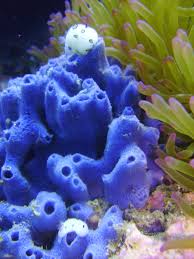
Spongers are filter feeders
Most invertebrates that do not move, or that move rarely are filter feeders, these include:
Tunicates
Sponges
Tube worms
Flame scallops
Spiny oysters
Clams
And giant clams
Filter feeders will feed on bacteria, detritus, and small amounts of juices and tiny particles from thawed-out frozen food. or on liquid coral foods.
It is easy and effective to use coral food as they are designed to feed both corals and filter feeding invertebrates. When you feed your corals the filter feeders will eat the left overs.
Scavengers:
The following clean up crew members eat leftover fish food scraps and small dead animals:
- Shrimp
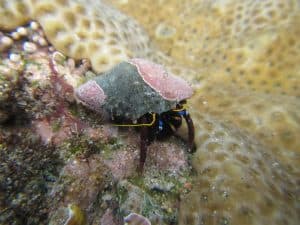
- Crabs
- Miniature purple lobster (Enomopletapus sp.)
- Nassarius snails.
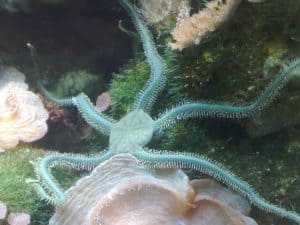
Green brittle stars will remain partially hidden at times, then burst into
activity and go on the hunt when they smell food scraps.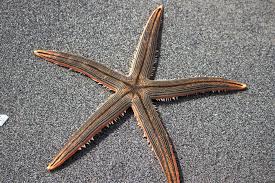
Sand sifting stars or burrowing starfish similar in appearance to this starfish feed on detritus and food in the sand.
Sand Sifting Scavengers:
The following are great at sifting through sand,
this provides oxygen to the bacteria in the sand, and as a result they
helps the sand to act as a biological filter. While sifting sand they eat leftover food and detritus (aquarium dirt), then they poop out the sand:- Sand sifting stars AKA burrowing stars
- Sea cucumbers
- Nassarius snails
Algae Eaters:
The following will eat algae:
- Turbo snails
- Cerith snails
- Nerite snails
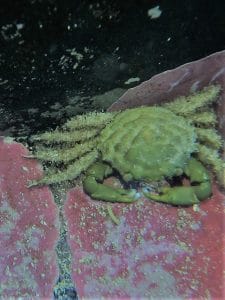
- Emerald Green crabs (specialized at eating bubble algae.)
- Blue leg hermit crabs are good at eating hair algae and cyanobacteria and general scavenging.
- Scarlet Hermit crab will eat algae and are general scavengers.
A Little Information About Bristle Worms
Some small bristle worms are good for the reef tank, some of these do not sting and only eat detritus. They are beneficial and will breed in the reef tank.
Some larger varieties are very troublesome and nibble on giant clams and corals in the night. Some even sting humans.
When I first moved from Ohio to Florida I was snorkeling off the coast of palm Beach, saw a large hairy bristle worm, thought to myself, that’s odd, it resembles in some ways a hairy caterpillar. I put my finger very near it but did not touch it. It’s hairs extended instantly and met my finger. I learned then that the pain was like a needle stuck deep into the flesh. I have never done that since.
I Its hard to tell the differenced between beneficial bristle worms and baby versions of the larger harmful stinging types that eat coral, so its best to get rid of them unless you are certain what you have.
- Arrow crabs eat bristle worms. A few Wrasses do as well. Also they make traps for bristle worms.
For more invertebrate choices see:
Starfish
Lobsters and Shrimp
Crabs
Snails
Clams
Giant Clams
Sponges
Saltwater Aquarium Plants
Clean up Crew Packages
Or Click Here For General Information On Invertebrates.