
And Other Bivalves
_______________________________________
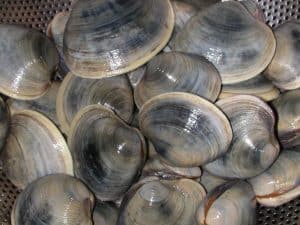
Clams
These marine aquarium clams are a great addition to your clean up crew, when not sifting your sand they are busy filtering small particulate matter and bacteria from the water that serves as their food. You can order them here, or you can learn more about them, and order them as part of a clean up crew package here.
Flame Scallop (Lima scabra) 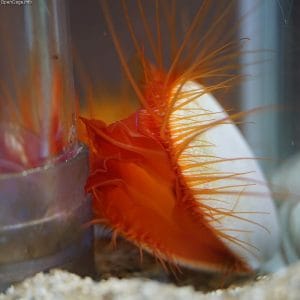
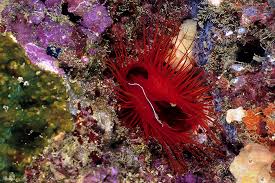
Electric Flame Scallop (Ctenoides scaber)
Flame Scallop (Lima scabra)
Beautiful, vibrant bright orange to red mantel with attractive matching tentacles that extend outside the shell. Occasionally they will exhibit varying degrees of white coloration as well. They are not actually scallops, but are in the Lima genus, thus are file clams. According to Rob Toonen, Ph.D in.advanced aquarist they often only live roughly 6 months in the aquarium, likely due to starvation. They require food in the 40 to 200 nm size range, In nature they eat primarily phytoplankton and planktonic larva. They will move around in a clumsy manner by clapping their shells together for a short period of time til they find a spot they like, usually one wedged partially between two live rocks. If they deem the spot suitable they will excrete threads from their shell called byssal threads that will anchor them in place. The one on the left looks like a flame scallop, the one on the right is obviously an electric flame scallop, the white thread like line on the mantle of the electric flame scallop to the right is not a white line, but a bio-luminescent strip of light that gives this scallop it’s electric name. The light turns on and off regularly. It is believed that it is designed to attract plankton that this filter feeder gradually sucks out of the surrounding water. In actuality both the above are electric flame scallops, the one on the left is just does not feel like producing noticeable light for the camera.
________________________________________
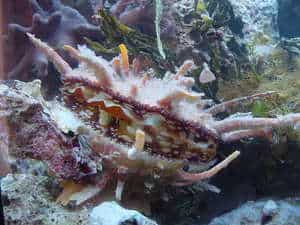
Spiny Oyster (Spondylus sp)
Above we learned that flame scallops are not scallops, but are file clams, and here we learn that spiny oysters are not oysters, but are a retaliative to scallops. Like scallops spiny oysters have rows of eyes along the mantle. Like scallops they have wing shaped projections on each side of the shells hinged end, though in spiny oysters the shell’s wing part is small and not very noticeable. It’s spiny shell is sometimes camouflaged with various species of sponges. They are filter feeders and also are reported to absorb nitrates from the water. They have a very long and interesting history throughout South America and Mexico and parts of Europe with humans often trading the shells and sometimes even using them as money. It would be difficult to go into a sea shell shop of any real size today and not find at least one of these animals spiny shells for sale.
For more invertebrate choices see:
Starfish
Lobsters and Shrimp
Crabs
Snails
Clams
Giant Clams
Sponges
Saltwater Aquarium Plants
Clean up Crew Packages
Or Click Here For General Information On Invertebrates.