
Lobsters
Like crabs, lobster and shrimp are crustaceans, all crustaceans require iodine to help them shed their old skins as they grow. In it not necessary to worry about their food because they are not picky and will find and happily consume any uneaten food scraps in the tank. All our lobsters are very colorful and make great scavengers. However, they grow fairly large, so it is best not to house them with small delicate invertebrates. They will not eat healthy fish or corals, and they will not harm all invertebrates, but they may eat some smaller more delicate bottom dwelling invertebrates so use caution. Construct overhangs with live rock so they can have a place to hide during the day. Try and construct hiding places and overhangs in such a way that they allow for viewing of the lobster that will often reside in such protected areas during daylight hours.
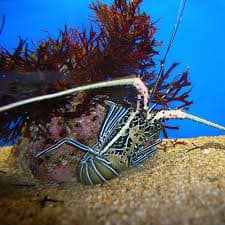
Blue Lobster (Panulirus Versicolor) Reef safe with caution.
Has no claws and is very similar in appearance to the edible Florida Spiny Lobster but is smaller and has blue legs. Grows up to eight inches. It has attractive blue lines on it’s legs and has a habit of swaying side to side. This is a larger scavenger with a good appetite and is reported to eat bristle worms. Will not bother coral or fish but may bother or eat some delicate invertebrates. Can be kept in groups of it’s own kind.
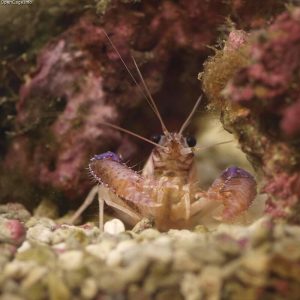
Debelius Lobster or Purple Reef Lobster (Enoplometopus sp.)
They display a nice purple and orange coloration, this picture does not do it justice. If you look close you may see the slightest hint of purple coloration on it’s claws. Grows up to six inches and is territorial, so must not be kept with others of it’s own kind.
Red Lob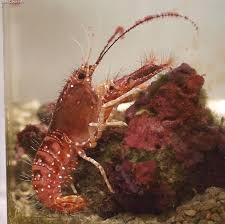 ster (Enoplometopus sp)
Another clawed beauty, this one has bright red coloration, this picture does not do it justice. It grows to five inches and is a very good scavenger. These are territorial so must not be kept with others of it’s own kind.
Shrimp
The following shrimp are attractive and are all reef tank safe shrimp, they will help clean the aquarium. Some of them are tank-raised. In fact it is not unusual to see round eggs under the tail of female shrimp. The eggs will hatch and sometimes you will see the young shrimp larva swimming around in the tank if you are in the right place at the right time. Unfortunately they will be sucked into filter returns before you get a glimpse of them in most causes. Because shrimp larva are prone to being sucked into filters, and because of difficulty providing a constant supply of micro algae it is difficult to raise shrimp at home.
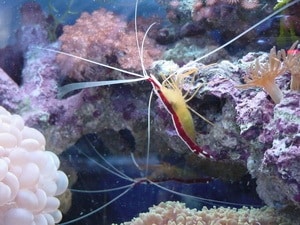
Skunk Cleaner Shrimp (lysmata sp)
Enjoys showing off its colors and cleaning parasites from fish.

Peppermint Shrimp
Great for devouring aiptasia anemone, they are affordable and very much enjoy the company of others of their kind.
Check Availability
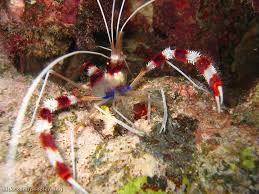
Coral Banded Shrimp or Boxing Shrimp (Stenopus sp)
They must be kept apart from other coral banded shrimps; they will fight unless you have a mated pair of coral banded shrimp. They do very well with all other reef tank-safe invertebrates. The beautiful and unusual appearance of this creature sometimes evokes questions from non-reef keeping observers, such as, “Is that a scorpion?”
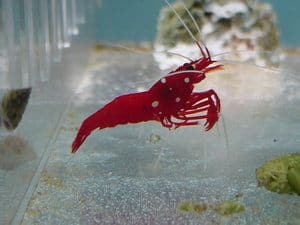
Blood Shrimp, Fire Shrimp, or Scarlet Shrimp (Lysmata Debelius)
This bright blood red shrimp with a few small white spots enjoys the company of others like itself.
For more invertebrate choices see:
Starfish
Lobsters and Shrimp
Crabs
Snails
Clams
Giant Clams
Sponges
Saltwater Aquarium Plants
Clean up Crew Packages
Or Click Here For General Information On Invertebrates.