
____________________________________
Sponges
Sponges are some of the most primitive inhabitants in reef tanks. Structurally, they are similar to a colony of one-celled organisms. Some sponges, if passed through a mesh, will not die. Instead, the separated cells will migrate toward one another and rejoin into a living sponge. A small sponge, four inches x one-half inches, can filter six gallons of water a day. They filter out microbes and other particulate matter, which will be used as food. Thus, they are very beneficial to the reef aquarium. These creatures are delicate but should survive in a reef tank habitat as long as a few basic needs are met. They have the same requirements as Tunicates: Very light feedings should be provided with the aid of a turkey baster. Try live foods such as rotifers, and live algae. Also try liquid foods such as Roti Rich, Kent Marine Coral Accel, Kent Marine Phyto Plex, and others. Juice from frozen fish food is also an excellent nourishment.
Our sponges are non-photosynthetic and do not require any light. They can be placed in a shady area of the reef aquarium such as a rocky overhang or shady crevice that are not suitable for corals. Some of these beneficial creatures will reproduce in the reef aquarium.
Sponges should never be exposed to air. Air bubbles become trapped in their pores and may result in death. Tip: Place the bag in the aquarium water, put a hole in the bag so the specimen can slowly acclimate to the aquarium water for fifteen minutes. Then, open the bag underwater and introduce the specimen to the aquarium.
________________________________________
Ball Sponge / Clump Sponge (Haliclona Compressa)


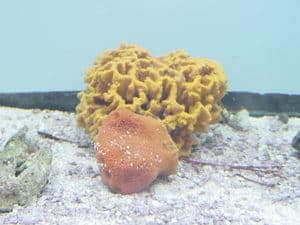
Yellow Tree Sponge (Amphimedon Compressa)
Red Tree Sponge (Amphimedon Compressa)
Orange Tree Sponge (Amphimedon Compressa)
Yellow Lettuce Sponge
Tunicates
Tunicates, also known as sea squirts, resemble sponges very closely. However, these unusual creatures are not at all related to sponges. In fact, sea squirts are the most advanced invertebrates suitable for the reef tank. Though appearing primitive, these creatures actually bridge the gap between invertebrates and vertebrates. In the larval stage, a Tunicate resembles a tadpole, complete with gill slits and a primitive backbone-like structure. Though more closely related to fish and other vertebrates in the reef tank, they fill the same niche as sponges They attach to live rock, add color to the reef tank and help to clean the water by filtering out microbes and other particulate matter, which they use as food. These creatures will thrive in a reef tank habitat as long as a few basic needs are met. They have the same requirements as sponges; light feedings should be provided in their vicinity with the aid of a turkey baster. They enjoy liquid foods, such as Roti Rich and Kent Marine Coral Accel. The juice and tiny particles from frozen fish food is excellent food as is live food, such as rotifers. Iodine is consumed rapidly. Calcium and strontium may be helpful.
Our Tunicates are non photosynthetic and should be placed in a shady area of the reef aquarium, such as a rocky overhang. Some of these beneficial creatures will reproduce in the reef aquarium.
Tunicate
Bright purple colony.
Purple jewel tunicates ( Eudistomas Sp.) These animals will be the most brightly colored item in your aquarium. Each colony is about 1/2 the size of a golf ball and a gorgeous deep rich purple color with about 6 to 12 individuals per colony. Externally the brightly colored tunicates appear primitive and resemble sponges. However the actual animals hidden inside the purple covering are quite advanced and are closely related to fish.
Tunicates also known as sea squirts are filter feeders and enjoy good water circulation. No special lighting required, in fact they appear to do best in low light. Feed small amounts of liquid food such as phytoplankton.
For more invertebrate choices see:
Starfish
Lobsters and Shrimp
Crabs
Snails
Clams
Giant Clams
Sponges
Saltwater Aquarium Plants
Clean up Crew Packages
Or Click Here For General Information On Invertebrates.