
Sea Anemones are very graceful , fascinating, and colorful additions to the reef tank. If you buy a sea anemone it will enjoy the the same conditions as your corals ( reef tank lighting, and moderate to strong circulation.)
Do your researche and add a sea anemone at your own risk because their is a chance that it will move around in your aquarium and sting any corals they touch.
Also do not forget to feed them a few times a month.
If an anemone is placed in a location of the reef tank with good light and good circulation, and is fed on a regular basis then it has no reason to move around and will in most cases stay put and be a peaceful addition to your reef tank.
Rock anemones also known as flower or sand anemones, as well as maxi mini carpet anemones are the most reef safe of all anemones even in very small tanks because they have very short tentacles and almost never move once they find a spot they like. Also they are very hardy. Curly Cue anemones are also very hardy and require little light. Most of the other specimens offered here should only be kept in a health reef tank with bright reef tank lighting at least four watts of light per gallon and good water circulation.
Saddle Carpet, Saddleback Anemone, Haddoni Anemone (Stichodactyla haddoni)
Indo pacific. (Good host for various clownfish.)
Usually olive green. Most hardy of the carpet anemones, very large and very beautiful, it is not unusual to see them grow to a foot across making them a nice centerpiece.

Long tentacle (Macrodactyla Doreensis)
Indo pacific. (Good host for various clownfish.)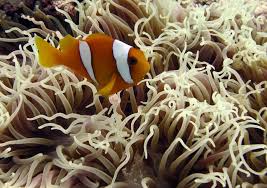
Often greenish tentacles and striped oral disk with red body. Will reproduce in the aquarium.

Rock Anemone AKA Flower Anemone AKA
Flower Rock Anemone (Epicystis Crucifer) Atlantic and Caribbean
(Not for clownfish)
Very hardy some are plain looking, occasionally a few can be very colorful.
Check Availability Tan / Gray / White
Check Availability Tan / Gray / Green
Check Availability Colorful
Maxi Min Carpet Anemone

Maxi-Mini Carpet Anemone, Stichodactyla tapetumi. (Not for clown fish but good for anemone shrimp and anemone crabs.)These anemones are a great example of the connection between mushroom corals and mushroom anemones. Take a close look and you will see that it looks like a large hairy mushroom anemone, look again and you will see that it looks like a miniature carpet anemone. They are actually a miniature carpet anemone, and should be fed on a regular basis, once a week or more should be fine. It is interesting to note that despite the amazing array of colors they come in, and their hardness, they are relatively new to the hobby when compared to other anemones. In nature they range from East Africa to Australia.
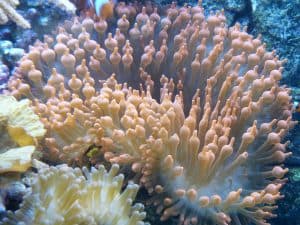
Bubble Tip Anemone (Entacmaea quadricolor,)
These are very hardy anemones and are common in reef aquariums.
When ordering a bubble tip anemone online it is best to only order it you can pick the color morph you want.
They come in three colors: tan, green, and pink. The pink ones are sometimes refereed to as rose bubble tip anemones.
They sometimes split and each section will become a new anemone. It is also possible to cut them in half as a form of propagation. They make great hosts for many types of clownfish.
Curly Cue Anemone Atlantic and Caribbean (Bartholomea Annulata) 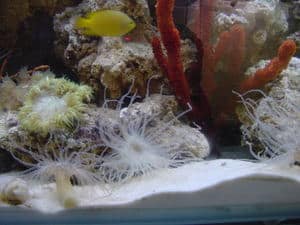
In this above photo you can see two curly cue anemones, and one rock flower sea anemone.
These very hardy anemone make a good host for various small clear cleaner shrimp: Peterson shrimp (Periclimenes Yucatanicus.) And (Periclimenes Pedersoni) Not for clown fish.
They are very hardy and do not require light so are a great candidate for placement under a shady ledge in a reef tank or even a fish tank with fish that are too large to be harmed.
This is a curly cue anemone also known the Corkscrew Anemone scientific name (Bartholomea Annulata) and not an Atapsia anemone scientific name (Aiptasia tagetes,) These are much larger than atapsia and are lighter in color and more graceful looking. Also they have a corkscrew pattern in the tentacles, I believe these corkscrew patterns to be groups of stinging cells, but this is not certain. Most importantly these will not spread in your tank and cause problems as the Atapsia are known to do.
Corkscrew do not move much as all. But because of the length of the tentacles and out stretched body be sure the keep them away from corals.
Condylactis (Condylactis ) Atlantic and Caribbean
(Not for clownfish)
Most common type offered in the aquarium trade. Attractive usually lavender, or pink and vary affordable. 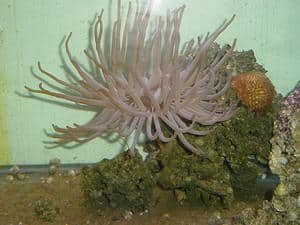
Hatian Anemone Giant Condylactis anemone (Condylactis Gigantea) 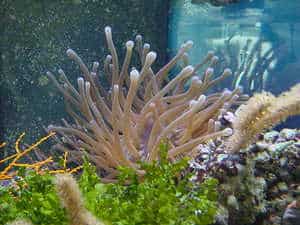
Atlantic and Caribbean
Good host for various small clear cleaner shrimp Peterson shrimp:(Periclimenes Yucatanicus.) And (Periclimenes Pedersoni)
Also Sexy Shrimp (Thor Amboinensis) Not for clownfish
Grows larger than the above typical condylactis and even more attractive but not as commonly found.
Its not only clownfish that can form a symbiotic relationship with anemones, but some shrimp do as well.
Here is a list of shrimp that often live among the tentacles of various anemones.
Anemone Shrimp
Peterson Shrimp: (Periclimenes Yucatanicus.) Or (Periclimenes Pedersoni)
or Sexy Shrimp (Thor Amboinensis)
Species vary depending on availability and unfortunately they are not always available at all. These various anemone shrimp make great companions for many of the above anemones especially the Atlantic species. Small but attractive shrimp with various markings remain unharmed among the swaying tentacles of anemones.
For more invertebrate choices see:
Starfish
Lobsters and Shrimp
Crabs
Snails
Clams
Giant Clams
Sponges
Saltwater Aquarium Plants
Clean up Crew Packages
Or Click Here For General Information On Invertebrates.