
Coral Symbiotic Zooxanthella and Reef Tank Lighting
Why do our corals require such specialized reef tank lighting systems?
To learn more continue reading,


to shop for reef tank lights online click here.
Before we can understand the special reef tank light requirements that corals present lets discuss the biology of corals in the wild. Corals themselves do not require any special lighting. It is the one-celled algae, known as zooxanthella, living inside the corals that requires special light.
The below image is a picture of some of the actual algae that lives inside coral.
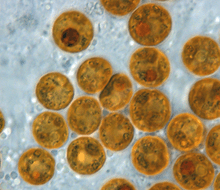
The algae and corals are obligatory symbionts of each other. This means that one cannot live without the other. This is why most coral reefs only grow in shallow, well-lit water. And this is why coral aquariums require bright lights.
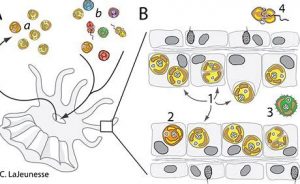
Below is a diagram showing an individual coral polyp on the left, and colorful algae cells entering and leaving its mouth from above. To the right are the algae cells as they appear when living inside the coral polyps cells.
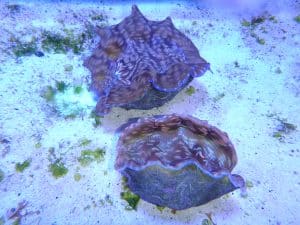
Its not just coral that have this special relationship with helpful algae. Various species of this algae have adapted to living inside the tissues of hard corals, soft corals, Cassiopeia jellyfish, some green tunicates, many sea anemones, giant clams, and a few other coral aquarium inhabitants.
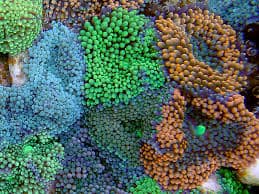
The above pictured corals are a type mushroom anemone called Ricordea. These animals that are a cross between coral and anemones receive some of their food and coloring from one-celled algae inside their tissues.
These algae are important to their host animals because they remove toxic metabolic waste products from the corals. These same waste products are a required nutrient for the algae. In return, the algae produce glucose and glycerol as high energy food for itself. However, the algae cell walls are very leaky. Half of the sugar that the algae produces for itself leaks out into the corals cells, where the coral can use this sugar as a food source. The algae are also beneficial in other ways. For example, in the presence of bright natural light or bright reef tank lights, the algae will remove carbon dioxide from the corals and produces oxygen. Tridacnid or giant clams will occasionally eat some of its algae thus using it as a more direct food source.
Reef tank lighting
Reef tank success depends largely upon how well your reef tank lighting system simulates the light of the natural environment from which its inhabitants have come. A very bright lighting system that simulates natural light is the main piece of equipment that makes a reef tank set up different from a saltwater fish tank set up. Your reef tank lighting should simulate natural light found at coral reefs in three ways:
Wavelength
Wavelength is measured in nanometers (nm). The wavelength must approximate what the animals would get from the sun in their natural habitat. Tropical noonday sun (at sea level) has a wavelength of around 6500nm
However, most corals don’t live at sea level but under the sea, where the light is a little bluer. As the intense tropical sunlight penetrates the water’s surface, it starts to change. At a depth of just one meter, almost all the red and half of the orange light is filtered out by the water. Other wavelengths of light are filtered out as the light goes deeper.
Because blue light travels in smaller and shorter waves, it has the ability to penetrate deep into the water without being absorbed. By the time the light reaches the coral, it is rich in blue light. The further below the surface the corals live, the higher the percentage of blue light it receives. The photosynthetic algae living inside the corals has adapted to utilizing this underwater light, which is rich in 420 nm actinic blue light. Also, some saltwater aquarium fish, and even more so corals, are more colorful under this blue light.
Photo period
Photo period (duration of exposure to light,) is important. In their natural environment, corals and other reef inhabitants are exposed to intense direct sunlight from about 9:00 am to about 3:00 PM. Less direct sunlight is received on the coral reef in the morning, as the sun rises, and in the evening, as the sun sets in the horizon. In the reef aquarium, corals should have bright reef tank lighting about twelve hours a day. If very bright lights, such as metal halides or bright LED lights are used above the tank, then lights do not need to stay on for twelve hours. Six or eight hours of metal halide lighting will be adequate. When attempting to provide a photo period for your aquarium, remember to use simple timers. These timers cost only a few dollars but are very beneficial. They can be found at your local hardware store. Timers are highly recommended for all lights and power heads.
Intensity
Not only are wavelength and photoperiod important, but intensity or amount of light is also very important. Scientists describe amounts of light in candle power or lumens. When choosing fixtures that provide the correct amount of light, we only need to consider the watts of power used by a light fixture. Four to 6 watts per gallon is adequate for reef aquariums.