
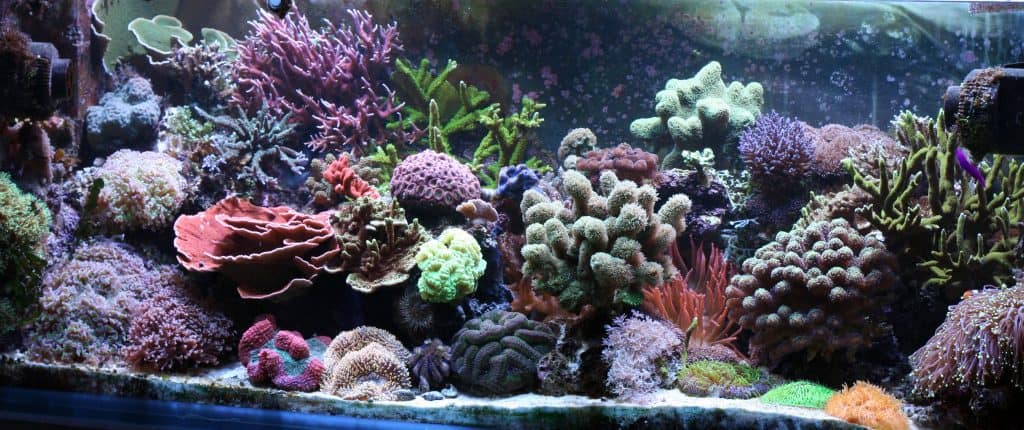
Large reef tank full of healthy live coral.
Let us offer you access to a very large selection of live coral including colorful small polyp stony corals, large polyp stony coral, soft corals, mushroom corals, polyps, and gorgonians all for sale online.
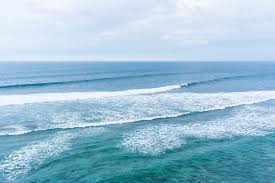
Coral reefs might be underwater cities crowded with life, but look all around the reef and above it. Around the reef is billions of gallons of pure salt water washing away any nutrients produced by the reef inhabitants. The ocean leaves only clean nutrient poor water for the reef inhabitants.
If you are ready to shop for live coral for sale click on the one of the above links, if you want more information about their care read on below:
Water quality:
We all know that coral reefs are all teaming with life, however when it comes to freely available nutrients floating around in the water column reefs are like nutrient poor deserts. Corals are adapted to these clean, clear, pristine ocean waters that are very low in free nutrients. Water around reefs have zero or near zero levels of nutrients such as ammonia, nitrites, and nitrates. In reefs these nutrients are absorbed as soon as they are released. So, in the aquarium we must replicate these conditions and provide clean, clean water with very low nutrient levels.
In the confines of the reef tank our live corals benefit from a good filtration system and a protein skimmer. In addition, they require monthly water changes with reverse osmosis water to maintain good water conditions like those at sea.
Additives:
In addition to the removal of organic nutrient like ammonia, nitrites, and nitrates, live corals require the regular addition non-organic minerals, they these can be easily added via individual reef tank additives containing molybdenum, strontium, calcium, or iodine, as they are consumed by corals during growth. For convenience you can purchase a collection of a few different reef tank additive together.
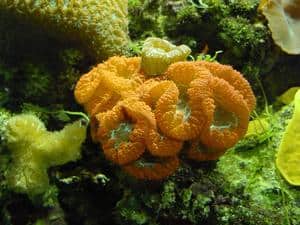
This Blastomussa is a common large polyp stony coral. The fleshy orange polyps are healthy, happy, and inflated. They require good clean water with low nutrient levels in order to be healthy and inflated. Under the fleshy polyps is a calcium carbonate skeleton. For growth such skeletons require small amounts of calcium and other minerals to be added to the aquariums water regularly.
Circulation:
Water movement is important for corals for two main reasons:
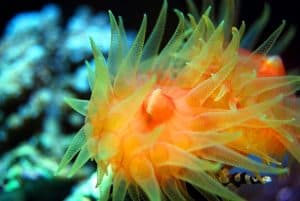
Look close at the tentacles on this sun coral polyp, they are pointing towards the right because of currents. Slight movement in the reef tank is astatically pleasing to humans and beneficial to coral health.
1) Circulation is like an external circulatory system for live corals, more complex animals like fish have an internal circulation system to remove carbon dioxide and nitrogenous waste products, and to provide oxygen and food in the form of glucose. Corals do not have such an internal system, so they rely on water currents around them to do the job.
2) It removes detritus off from corals surfaces, if not removed these dirt like aquarium sediments will cause the corals to decay wherever detritus is allowed to build up for extended periods of time.
In a reef tank, healthy happy living corals should at least sometimes extend colorful showy polyps. It does not hurt to provide enough circulation via a reef tank wavemaker system. You should provide at least a little movement in the softer parts of your corals.
You can find more specific circulation recommendations in the sections for specific types of corals.
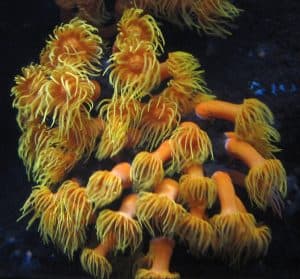
The corals in this sun coral are equipped to sing and feed on food, in fact this coral is so well equipped for feeding on solid food that it does not require sun light at all. While scuba diving I have seen thousands growing deep inside dark shipwrecks. Other times they will grow on boat docks inches from the surface in South Florida’s intense sun.
Food:
Feed live aquarium corals small amounts of thawed-out frozen fish food, such as reef plus, reef stroganoff, brine shrimp, chopped up silversides, etc., Chunks of food about 1/4 inch or less or about the size of an adult brine shrimp will suffice in most cases. This is great for large polyp stony corals. Small polyp stony corals have smaller polyps so benefit from much smaller pieces of food such as pieces the size of a baby brine shrimp or lie the size of the period at the end of this sentence. Live plankton type foods can also be helpful for small polyp corals. The many liquid coral foods available for sale online also work well for them. Soft corals benefit from liquid foods, and zooplankton in the form of very fine particles as well as liquid marine algae. Feed tiny amounts to any reef tank, and no not forget what we discussed above about the importance of clean water. Coral foods, just like fish food when in excess are the enemy of clean water. Feed about once a week roughly, this can be very helpful but don’t overdo the feeding. It is better to err on the side of caution and not feed much as all. Many corals can go several years or possibly indefinitely without being fed directly.
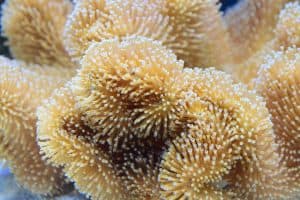
The fuzzy or hairy projections that look like tentacles on this toadstool leather are not tentacles, they are thousands of polyps. Each polyp has eight very tiny tentacles visible in real life, but not visible in this image. The tentacles are tiny and weak and not equipped for stinging, defense, or feeding on solid foods. It will eat not solids. The coral may absorb small amounts of liquid nutrients, bacterial, and singled celled algae from the surrounding water.
Lighting:
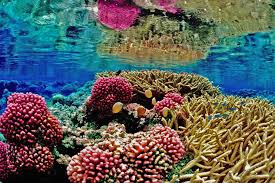
Most corals grow in shallow tropical areas a few foot, to several meters below the surface where they always experience bright light, long days, and no winter.
It is easy to replicate this with the right lighting systems. Use around four to ten watts of lighting per gallon. Power compact lighting is effective. Metal halide is more powerful but produces much waste heat. The best systems of all for all types of tanks including reef tanks are the LED light systems.
Nano reef tanks often work well with a simple clamp on goose neck LED. Place small polyp corals go towards the top of the tank near the lights, more colorful corals also often benefit from brighter lights. Large polyp corals often do not require quite as much light as small polyp stony corals. Soft corals and mushrooms can often go towards the bottom of the tank as they require less light than the above referenced hard coral types.
Coral Warfare:
A important thing to remember about live coral specimens is to space them apart at least a few inches so they do not sting each other at night. In general, large polyp stony corals have larger stinging tentacles that come out at night to fight for territory. Small polyp corals tentacles only extend a very short distance in most cases. They do not have long tentacle but still need to be placed apart so they do not touch each other directly, or grow into each other, thus they need space like plants in a garden. And soft corals need a little space as well because they release chemicals to keep neighbors growth under control in a type of war for space.
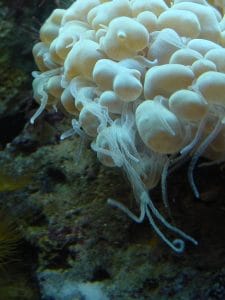
Note the stinging sweeper tentacles have decided to come out. Space large polyp corals apart by a few inches so they do not sting each other with stinging sweeper tentacles. These tentacles are often only seen at night or during feeding time.
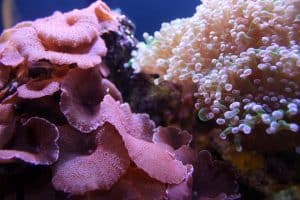
Corals wage war for space where they have access to currents, light, and food unhampered by neighbors. Look at how this frog spawn on the right and the mushrooms on the left are close but not touching, it is as if the mushrooms are pulling away from the stinging tentacles of the frog spawn coral on the right.