
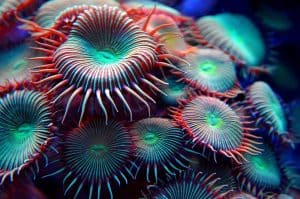
Coral Type: Polyps
TO ORDER POLYP TYPE CORALS SCROLL DOWN THIS PAGE
Polyp corals (button polyps, sea mat, star polyps, pulsing xenia and others) can be found in this area of our shop. They are a very easy to maintain salt water aquarium coral, many polyps resemble a colony of anemones, others such as green star polyps resemble a forest of tiny palm trees. Polyp corals do not form a hard calcium skeleton. These polyps are a diverse group of corals that occupy a wide variety of saltwater environments. They come in various colors and forms. Many pet shops that carry live coral and salt water aquarium fish are happy to trade pulsing xenia polyps, and other similar fast growing corals for store credit with hobbyists who harvest them from their reef tanks.
General: Polyps are very hearty aquarium coral and should do well and grow in a healthy reef tank. They benefit from the good water quality provided by monthly partial water changes with reverse osmosis but they are not as picky about water quality as other corals. They are good specimens for beginners.
Additives: Very important are additives containing iodine, especially for pulsing xenia. It is consumed rapidly.
Circulation: Provide moderate circulation.
Lighting: Many polyps do well with standard amounts of VHO lighting of at least four to six watts per gallon. Better growth can be expected under stronger lighting from led or metal halide lights.
Food: Polyp corals that resemble a colony of anemones will eat solid food if it is placed on them gently. First, turn off power heads, or the food will be carried away. Feeding small amounts of thawed frozen food, such as reef plus, reef stroganoff, brine shrimp plus, etc., about once a week or less is suggested. Most others, such as star polyps and clove polyps (clavularia), pipe coral (tubipora), pulsing xenia, and the closely related anthelia do not take solid food. They more resemble a grove of tiny palm trees. These absorb tiny particles and dissolved nutrients into their bodies. Add small amounts of Roti Rich, Kent Marine’s Coral Accel, Kent Marine Phyto Plex, or juice from frozen foods.
Placement: Like mushroom corals, most polyp type soft corals do not require as much lights as some other corals, so they can often be placed towards the bottom of the tank and in other lower light areas.
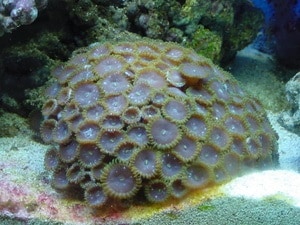
Green Polyps (Palythoa or Zooanthus sp)
Shop super green polyps here
Colorful Polyps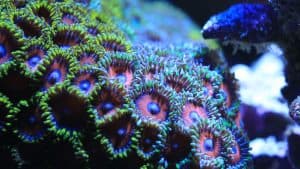
Colorful polyp coral species come in a variety of colors and patterns and many have
bold and suggestive names that go along with their appearance.
These are some of the most colorful and beautiful corals you will find.
Individual polyps are small typically 1/4 inch across or less, but several typically grow together in a small colony and
hundreds may often be found in some larger colonies. Easy to maintain and will reproduce in the tank naturally. If cutting them for propagation be sure to wear goggles because they may squirt out a toxic watery liquid that can case pain or damage if it gets in your eyes.
Shop colorful eagle eye polyps here
Shop colorful orange polyps here
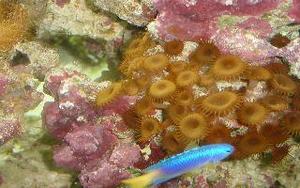
Brownish Green Button Polyp coral (Palythoa sp)
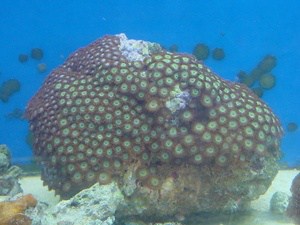
Green Sea Mat (Palythoa sp)
Nice green color. Sometimes with sponges or nice macro algae attached to the colony. Enjoys strong light.
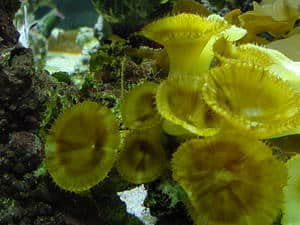
Large Cinnamon Polyp or Grand Polyps (Palythoa Grandis)
Cap of each polyp grows to about one inch across. Place in lower light areas.
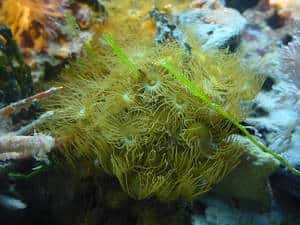
A hardy coral with large bright yellow polyps displaying graceful threadlike tentacles.
Yellow Polyps (Parazoanthus gracilis)
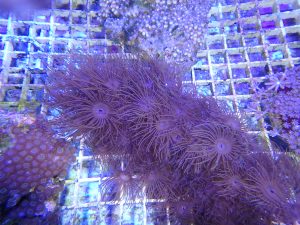
Stick Polyps (Parazoanthus Swiftii)
Cap of each polyp grows to about one inch across. Place in lower light area.
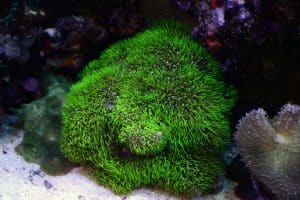
Fluorescent Green Star Polyps (Clavularis viridis)
Note the bright green color. Colony shown is larger than what is typically for sale, but these corals will easily grow and spread in a healthy reef tank.
Shop green star polyps here.
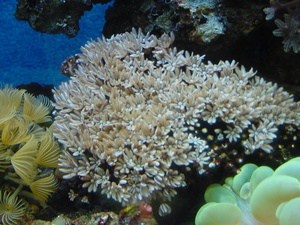
Pipe Organ Coral (Tubipora musica)
This coral forms a red skeleton like a hard coral would be expected to form, however technically, it’s a soft coral similar to the star polyps.
Anthelia or Creeping Xenia (Anthelia sp)
Anthelia is very similar to xenia (it sometimes even pulses like xenia); however, anthelia grows into a bushy form from a creeping mat while xenia grows treelike from a stalk.
Xenia (Xenia elongata) 
A fast growing coral. Pet shops will often trade store credit in exchange for xenia that you harvest from your tank.
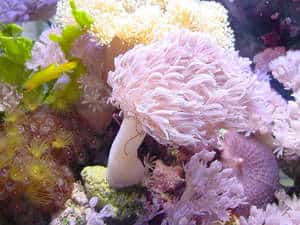
White Xenia or Pom Pom Xenia (xenia umbellata)
Similar to the above but shorter, more attractive, and more graceful. Also harder to find.
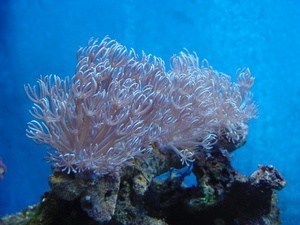
Silver tip pulsing xenia.
A fast growing coral. Pet shops will often trade store credit in exchange for xenia that you harvest from your tank.
Clove Polyps ( Clavularia sp.) 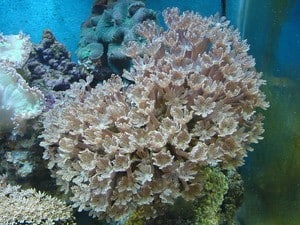
Clove polyps can be tan, some can have a very beautiful neon green coloration in the center of each polyp. They are known to grow rapidly in the reef tank and are hardy.
Daisy clove polyps and green clove polyps.
Glove polyps with a G not to be confused with it’s extremely close relative
Clove polyps with a C. These polyps have larger tentacles the more closely resemble palm tree fronds.
Glove Polyps The Blue and Green Sympodium, Sympodium sp
Sympodium is somewhat similar in appearance to clove polyps but with much smaller yet densely packed polyps with a richer deeper very beautiful coloration. This is a very easy coral to care for.
Shop Sympodium Here
General Coral Information
LPS Coral
SPS Coral
Mushrooms Anemones
Soft Corals
Polyp Corals
Gorgonians